Design your tour!
We will help you create
China-Tour of your dreams!
FREE QUOTE
12 Day Golden China Tour
China Travel - Custom Tour
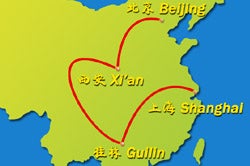
One of the classic China Tour : Beijing / Xi'an / Guilin / Yangshuo / Shanghai.
Includes visit of the Forbidden City, the Great Wall, Xi'an Terracotta warriors, Li River Cruise, and many more...
| Duration: | 12 days 11 nights |
| Departure: | Daily |
| Price: | From US$1200 * |
Tour Map :
Included Features :
3 domestic flights (Beijing - Xi'an, Xi'an - Guilin, Guilin - Shanghai), ground transportation and all transfers
Accommodations at deluxe hotels with private bath
Comprehensive touring program including entrance fees
Professional English-speaking Tour Director and local guides
* The price depends on the number of travelers, season, accomodation options, extra-activities, extra-places, or tour-guide request.
Activities & Attractions :
Other tours:
China Travel - Custom Tour
One of the classic China Tour : Beijing / Xi'an / Shanghai.
Includes visit of the Forbidden City, the Great Wall, Xi'an Terracotta warriors, and many more...
Day by Day Itinerary
B : Breakfast - L : Lunch - D : Dinner
Day1:
Arrive Beijing.
Upon your arrival at Beijing airport, our local guide will meet you and escort you to your hotel. The rest of the day is free at your own leisure.
 Day 4:
Beijing
Day 4:
Beijing
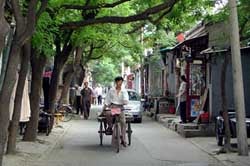
After breakfast, you will first visit Beijing's traditional Hutongs. And then the Summer Palace. (B, L, )
 Day 5:
Beijing / Xi'an.
Day 5:
Beijing / Xi'an.
Free in the day until our local guide escorts you to the airport for your onward flight to your next destination : Xi'an.
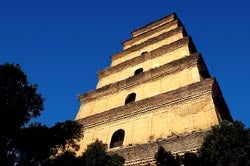
Upon your arrival, our local guide will meet you and escort you to your hotel. In the afternoon, you will have city tour to the Shaanxi Provincial Museum and the Big Wild Goose Pagoda. Complete the day with a savory dumpling dinner. (B, L, D)
 Day 7:
Xi'an / Guilin.
Day 7:
Xi'an / Guilin.
Free until our guide meets and helps you transfer to the airport for your flight to Guilin. Transfer to your hotel.
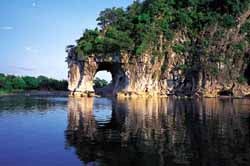
Then visit of the most scenic city in China wich includes the Elephant Trunk Hill, the Fubo Hill and the Reed Flute Cave.
 Day 8:
Guilin / Yangshuo.
Day 8:
Guilin / Yangshuo.
After breakfast, board for a 4 hours boat cruise on the beautiful Li River, the highlight in Guilin to Yangshuo. Free time in the afternoon after checking in the hotel in Yangshuo.
 Day 9:
Yangshuo.
Day 9:
Yangshuo.
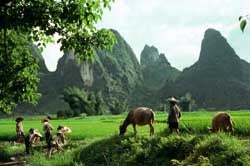
Morning, you will have an excursion to the Moon Hill and the Big Banyan Tree Park, along the route a serene pastoral view of fantastic limestone mountains, peaceful farming villages with long stretch of rice fields and roaming water buffaloes spreads in front of you. You will also have the chance to pay a visit to one of the local farmers’ home en route, the rest of the day is yours to explore this lovely county.
 Day 10:
Yangshuo / Guilin / Shanghai.
Day 10:
Yangshuo / Guilin / Shanghai.
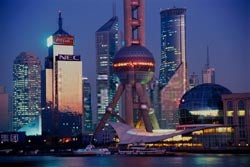
Today, drive back to Guilin and have a visit to the Seven Star Park before your transfer to the airport for your flight to Shanghai. After your arrival at Shanghai, our local guide will meet you and escort you to your hotel.
Day 12:
Shanghai / End.
Day free until our local guide escorts you to the airport.
Activities & Attractions Overview
The Tian'anmen (Gate of Heavenly Peace) Square
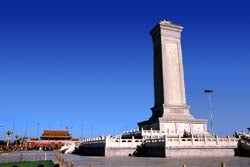
The largest city square in the world and the spiritual heart of China, where the national flag is raised exactly at sunrise everyday
The Forbidden City
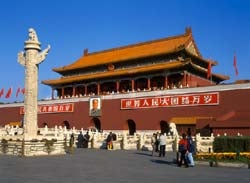
Located in the center of Beijing, used to be the imperial palace of the Ming and Qing dynasties with a history of around 600 years, it is the grandest integral palace complex still remaining in China.
The Temple of Heaven
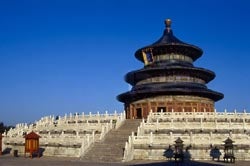
The place which was visited yearly by the emperors who performed intricate rituals to insure a good harvest for the whole nation at ancient times.
The Peking Opera
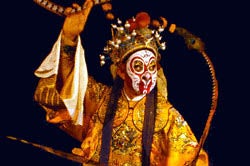
A kind of singing drama which is an ingenious and colorful combination of elements from many sources: traditional music, poetry, singing, recitation, dancing, acrobatics, and martial arts.
The Great Wall
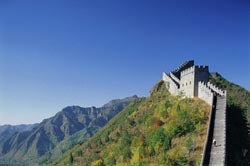
The most famous symbol of China and one of the world's most remarkable architectural wonders, it was built over 2,000 years ago and stretching about 6,700km.
The Ming Tomb
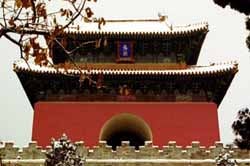
The burial site of Wanli emperor, the 13th emperor of the Ming Dynasty who ruled for 48 years until his death in 1620, it is the only underground tomb of the thirteen tombs of the emperors.
The Sacred Road
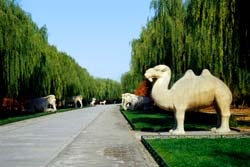
The path lined with stone statues of animals, mystical beasts and officials who serve the emperor in his afterlife, through which the sitting emperors would go to perform memorial rituals for the ancestors once a year.
Beijing Hutongs
The old narrow paths with lots of courtyard homes where common people are living, they are like villages within megalopolis, through the hutongs' teeming maze of alleyways, you will see the old houses and learn about the daily life of ordinary Beijing citizens.
The Summer Palace
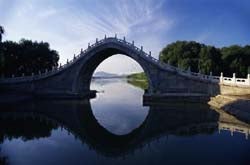
Located on the northwestern outskirts of the city, it was an imperial summer resort of the Qing Dynasty. With its perfect layout, magnificent buildings and enchanting landscape, it is the most splendid classical garden in China.
The Shaanxi Provincial Museum
Opened in 1991, the largest comprehensive museum in the province, the museum exhibits over 3,000 unearthed historical relics, a small fraction of their collection, most of the exhibited items are rare treasures, showing you the splendid Chinese culture.
Big Wild Goose Pagoda
Regarded by many as a symbol of the city, the pagoda was built in 652 A.D in Tang Dynasty to house the sutras brought back from India by the famous monk Xuan-zang.
Terracotta Warriors and Horses
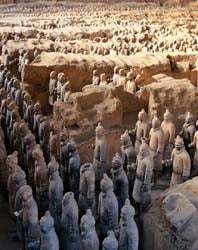
Discovered in 1974 by local farmers digging a well, one of the most significant archeological finds of the 20th century. These 6,000 life-size painted terracotta warriors and horses, individually sculpted from real-life models and arranged in battle formation, have been protecting the mausoleum of the first emperor in Chinese history - Emperor QinShihuang - 2,200 years ago.
Xi'an Ancient City Walls
Built during the 14th century on Tang dynasty foundations, date to the Ming dynasty, the walls are the largest and best-preserved ancient fortress in the world. There is a gate in each of the four sides, the gate towers built over each gate look lofty and magnificent and form a tight defence engineering system.
Bell Tower
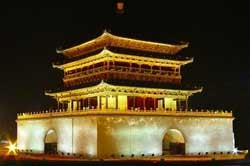
Standing in the center of the city and built in 1582, the Bell Tower is a three-story wooden structure with traditional Chinese architectural features, it is so called because an iron bell is hung in the tower to give the correct time.
|
Elephant Trunk Hill
The symbol of Guilin, which resembles a giant elephant drinking water from the Li River.
Fubo Hill
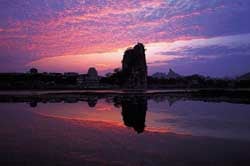
Where you can see lots of statues of Buddha left about 1000 years ago in the Returned Pearl Cave and have birds'eye view of the whole city after climbing up to the very top.
Reed Flute Cave
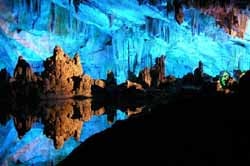
5 kilometers away from the city center, famed as “A Natural Palace of Art”, in which you can see lots of stalactites & stalagmites illuminated by the lights of different colors and learn how they were formed.
Li River Cruise
Along the river, you will be inspired by breathtaking views of peaks and pinnacles, crystal-clear water and reflections in the water together with the serene pastoral views of rice paddies and water buffaloes, you are certainly walking into a traditional Chinese painting by cruising on it.
Yangshuo County
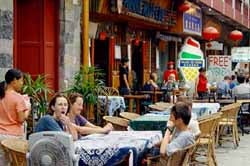
Founded in 590 AD, Yangshuo County has been booming because of tourism. With so many unique mountains surrounding, it is described as “the world of green lotus and jade bamboo shoots”.
Moon Hill
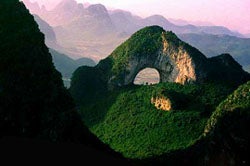
Viewed from different places, the moon takes on different shapes, sometimes full moon, sometimes half-moon and sometimes crescent, forming a marvelous spectacle in Yangshuo, climbing about 800 steps up to the very top, you will have a fantastic view of the whole county.
Big Banyan Tree
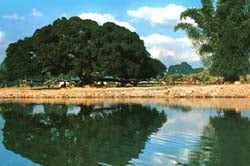
More than 1500 years old, with its crown covering more than half a hectare, it was once the spot where “Third Sister Liu” who was the folk song singer of Zhuang people sang beautiful melodies according to the legend.
Seven Star Park
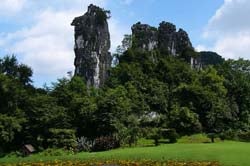
It is the largest and the most-visited park in Guilin. Visit the Camel Hill, the Seven Star Cave, the Floral Bridge, and the Zoo.
Shanghai Museum
Often ranked as China's best museum, it is the biggest museum in China with a fine collection of over 120,000 pieces of Chinese artifacts.
The Bund
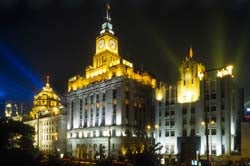
The word “Bund” was derived from Anglo-Indian word meaning quay. That's where the great trading houses and banks had their headquarters in 1920s and 1930s, about a mile long, it is the city's fulcrum.
Nanjing Road
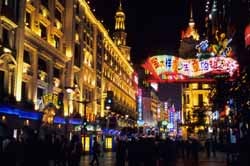
Known as “China's No.1 Shopping Street” with a huge of merchandise on sale.
Yu Garden
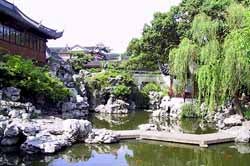
Located in the Old Town of Shanghai and laid out in 1559 AD by a powerful Ming official, Yu Garden recreates a beautiful landscape of pagodas, pavilions, rockeries, fountains, ancient trees and precious flowers.
Yuyuan Market
Outside the Yu Garden, a bustling market with different snacks and trinkets.
|
|